
Market benchmark BSE Sensex rallied 635 points to 59,942 in the opening trade of the special Muhurat session on Monday to mark the beginning of Hindu Samvat year 2079. The 30-share index was trading higher by 635.12 points, or 1.07 per cent, at 59,942.27 in the first few minutes of trade. Similarly, the broader NSE Nifty surged 192.20 points or 1.09 per cent to 17,768.50.

Indian companies are planning to increase investments in the new year to expand capacity, acquire companies, and go on a hiring spree, a survey of top executives showed. They, however, cited rising costs, weak consumer demand, and increasing interest rates as major concerns for 2023 which may impact their plans.

Planet Earth welcomed its 8th billion inhabitant on Tuesday, a remarkable milestone for humanity that is set to propel India to become the world's most populous country next year, surpassing China amid rising global challenges.

Rating agencies Crisil and Icra on Monday revised down their India growth projections for the current fiscal and the second quarter mainly due to the ripple effect of slowdown in global growth and mixed crop output. Crisil downgraded the India growth forecast by 30 bps to 7 per cent while Icra pegged the economic expansion at 6.5 per cent for the second quarter of FY2022-23. "We have revised down our forecast for real gross domestic product growth to 7 per cent for fiscal 2023 from 7.3 per cent, primarily because of the slowdown in global growth that has started to impact our exports and industrial activity.

'We would like to develop Andhra Pradesh into a logistics hub not only for India, but also for South Asia.'

'Although Hong Kong weathered many a storm and displayed a remarkable resilience to bounce back, the developments in the territory have raised question marks with regard to its future stability and prosperity.' A revealing excerpt from Rup Narayan Das's Hong Kong Conundrum: Pangs of Transition.

Manufacturing activities in India remained robust and price pressures were contained in October as new orders and production rose at a slower but stronger pace, according to a monthly survey released on Tuesday. The seasonally-adjusted S&P Global India Manufacturing Purchasing Managers' Index (PMI) was up from 55.1 in September to 55.3 in October. The October PMI data pointed to an improvement in overall operating conditions for the 16th straight month.

Finance Minister Nirmala Sitharaman will kick start the customary pre-Budget consultation exercise with stakeholders from Wednesday by holding the first such meeting with experts of agriculture and agro-processing industry. She will be seeking inputs from various stakeholders, including industry bodies, farmer organisations and economists for reviving consumption and boosting growth hit by the COVID-19 pandemic. The growth this year is expected to be in the double-digit during the current fiscal.

The farm sector has been resilient to the COVID-19 shock and is estimated to grow at 3.9 per cent this fiscal, the Economic Survey said on Monday, while suggesting to the government to give priority to crop diversification, allied farm sectors and alternative fertilisers like Nano urea. The Economic Survey 2021-22 also pitched for increasing agriculture research and development (R&D) and organic farming, besides use of new technologies like drones. "The performance of the agriculture and the allied sector has been resilient to the COVID-19 shock. ...Growth in allied sectors including livestock, dairying and fisheries has been the major drivers of overall growth in the sector," the Survey said. The agriculture sector has experienced buoyant growth in the past two years.

Biden praised India's Covid vaccination efforts.
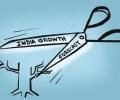
Global forecasting firm Oxford Economics on Monday revised downwards its India GDP growth forecast for 2021 to 10.2 per cent from 11.8 per cent previously, citing the country's escalating health burden, faltering vaccination rate and lack of a convincing government strategy to contain the pandemic. Oxford Economics also said that notwithstanding the likelihood of further mobility restrictions, it expects India's targeted lockdown approach, less stringent restrictions, and resilient consumer and business behaviour to mitigate the economic impact of the second wave.

India has been relatively insulated from the severe headwinds in the West. However, with a third of the global economy expected to slip into recession in calendar year 2023, the impact will strongly be felt on India's exports and trade economy, leading economists said in a panel discussion at the Business Standard BFSI Insight Summit in Mumbai on Wednesday. The panel comprised former Reserve Bank of India executive director and former Monetary Policy Committee member Mridul Saggar, State Bank of India Chief Economic Advisor Soumya Kanti Ghosh, Citibank India Chief Economist Samiran Chakraborty, ICRA Chief Economist Aditi Nayar, and IndusInd Bank Chief Economist Gaurav Kapoor. The topic of the panel discussion was No recession in sight: Is India decoupled from developed economies?

Foreign Secretary Vinay Kwatra on Wednesday refused to speculate on whether the G20 foreign ministers' meeting would be able to come out with a joint communique against the backdrop of widening differences between the West and Russia on the Ukraine conflict.

'Putting tanks on the Ladakh border is not enough to combat China, what is needed to ensure resilience against any cyber-attacks or attacks in outer space or China flexing its economic muscle, as it did with Australia.'
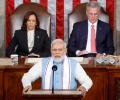
Here's the full text of Prime Minister Narendra Modi's address to a joint session of the United States Congress, delivered on Thursday.

'Given the worries about sluggish growth, rising interest rates and likely volatility, it's quite logical to infer that the SIP route could be the preferred way of investing.'

Mixed earnings and not so encouraging macroeconomic data dented sentiment, Ajit Mishra, VP - Research, Religare Broking Ltd said. In twin blows to Indian economic revival, higher food prices drove retail inflation to a five-month high of 7.4 per cent, while factory output fell for the first time in 18 months. The second consecutive month of rise in consumer price index (CPI)-based inflation will add to the pressure on the Reserve Bank of India (RBI) to again raise interest rates to tame high prices. In the broader market, BSE Midcap declined 0.73 per cent while smallcap dropped 0.45 per cent.

Prime Minister Narendra Modi on Monday met his British counterpart Boris Johnson on the sidelines of the COP26 climate summit here and discussed ways to enhance bilateral cooperation in areas like green hydrogen, renewables and clean technology, economy and defence.

"In India's development cooperation, we will be guided by our partners' development priorities. Our assistance does not create indebtedness and is without conditionalities," he said at the 44th Annual Meeting of the G-77 Foreign Ministers on Thursday, in a veiled reference to China's loans which has led to debt-traps in some countries.

For the banking system a new cycle starts in FY2024. It's fraught with fresh challenges on asset quality and profitability, warns Tamal Bandyopadhyay.

'Markets could face uncertainty in the short to medium term.' 'It would be prudent to invest in alternative asset classes, especially debt, for about a year.' 'Bank fixed deposits are offering rates as high as 9 per cent per annum and these can be used as a great hedging tool until equity markets stabilise.'

Within days of announcing mega investments for building in Hyderabad its second data centre cluster in India, Amazon Web Services (AWS) on Monday said it is excited about the India market, where cloud adoption offers massive headroom for growth. Pledging its long-term commitment to the India market, AWS, Amazon's cloud computing unit, said it expects global uncertainties to accelerate the decisions by companies to opt for flexible, on-demand cloud infrastructure to pare costs, gain efficiencies and drive business innovation. "Cloud reacts well to uncertainty," Puneet Chandok, president - commercial business, AWS India and South Asia, Amazon Internet Services Pvt Ltd (AISPL) told PTI.

Labour Leader Keir Starmer told a gathering of hundreds of British Indians that he was determined to put an end to 'divisive politics' and extremist elements exploiting social media to spread hatred within communities.

Rebalance the portfolio at least once a year to ensure it remains in sync with the target asset allocation.

Bank credit is likely to grow at a four-year high of 11-12 per cent in fiscal 2023, on the back of better economic growth and budgetary support from the government, according to a report. In the fiscal ended March 2022, bank advances have likely grown at 9-10 per cent. "Healthy economic growth and budgetary support from the government should lift bank credit growth by 200-300 basis points to 11-12 per cent this fiscal," Crisil Ratings said in the report. The higher credit growth expectation is also supported by the improved resilience of the banking system, it added.

PowerGrid was the top loser in the Sensex pack, slumping over 4 per cent, followed by ONGC, IndusInd Bank, Kotak Bank, L&T, Asian Paints and Bajaj Auto. NSE Nifty tanked 258.40 points to 14,359.45.

Macroeconomic data announcement, Omicron situation and global trends will be the major driving factors for the equity market in the first week of the new year 2022, according to analysts. In what turned out to be a historic year, the Indian stock indices went past multiple milestones and the 30-share Sensex made an annual gain of 10,502.49 points or 21.99 per cent in 2021. Religare Broking Vice-President (Research) Ajit Mishra said, "This week marks the beginning of a new month and participants will be closely eyeing some crucial high-frequency data like monthly auto sales, India manufacturing PMI and India services PMI. "Besides, updates on the COVID-19 situation and performance of global markets will also be critical."

The World Bank has approved loans totalling $1.75 billion (about Rs 13,834.54 crore) to fund India's PM Ayushman Bharat scheme and private investment to boost the economic growth. Of the total loan, $1 billion will go towards the health sector, while the rest $750 million will be in the form of development policy loan (DPL) to fill the financing gaps through private sector investment in the economy. The World Bank Board of Executive Directors approved two complementary loans of $500 million each to support and enhance India's health sector.

The Indian services sector activity fell to a six-month low in September, as new business inflows rose at the slowest rates since March, amid inflationary pressures and competitive conditions, a monthly survey said. The seasonally adjusted S&P Global India Services PMI Business Activity Index fell to 54.3 in September, from 57.2 in August, highlighting the weakest rate of expansion since March. For the fourteenth straight month, the services sector witnessed an expansion in output. In Purchasing Managers' Index (PMI) parlance, a print above 50 means expansion, while a score below 50 denotes contraction.
India's services sector activity witnessed a sharp upturn in August on the back of stronger gains in new business, ongoing improvements in demand conditions and job creation, a monthly survey said on Monday. The seasonally adjusted S&P Global India Services PMI Business Activity Index rose from July's four-month low of 55.5 to 57.2 in August, amid a quicker upturn in business activity and the sharpest rise in employment for over 14 years. For the thirteenth straight month, the services sector witnessed an expansion in output.

Facing the twin task of fighting the coronavirus pandemic today and building a better tomorrow, the world is experiencing a new Bretton Woods moment, IMF managing director Kristalina Georgieva said

RRR threw a lifeline, or so it seemed -- to a world that was down in the dumps. Keeravani and his Naatu Naatu just happened to be in the right place at the right time, notes Saibal Chatterjee.

The first step to keeping your job safe, experts tell Rediff.com's Divya Nair, is understanding why layoffs happen.

This is a terrible situation for a growing economy to be in, and the central bank would be expected to act to correct the situation.

Prime Minister Narendra Modi and his Japanese counterpart Yoshihide Suga met in Washington, DC, on Thursday to discuss ways to further cement the bilateral strategic ties ahead of the first in-person Quad meeting to be hosted by US President Joe Biden.

The prime minister will leave for the Indonesian city of Bali on Monday on a three-day visit to attend the summit that is expected to deliberate extensively on pressing global challenges including the Ukraine conflict and its implications.

Here's the full text of address to the nation by President Droupadi Murmu on the eve of the Republic Day 2023.

Mortgage lender HDFC on Wednesday said it has approved the highest ever retail home loans of over Rs 2 lakh crore in 2021-22. The demand for these loans was from across the country, HDFC said in a statement. HDFC managing director Renu Sud Karnad said, "In over four and half decades, I have not seen a better time for the housing sector than now due to lower interest rates, stable property prices, government's thrust on affordable housing, improved affordability, favourable demographics, increasing urbanisation and rising aspirations." The residential real estate segment will continue to see strong traction going forward, as the demand for housing is not just pent up demand but is a structural one, she said.

India's economy, estimated to contract by 6.9 per cent in 2020 due to the coronavirus pandemic, is forecast to record a "stronger recovery" in 2021 and grow by 5 per cent, according to a UN report which said the country's current fiscal year budget points to a shift towards demand-side stimulus, with an uptick in public investment. The report, 'Out of the frying pan ...Into the fire?' published Thursday as an update to the Trade and Development Report 2020 by UN Conference on Trade and Development (UNCTAD) said the global economy is set to grow by 4.7 per cent this year, faster than the 4.3 per cent predicted in September 2020, thanks in part to a stronger recovery in the US, where progress in distributing vaccines and a fresh fiscal stimulus of $1.9 trillion are expected to boost consumer spending.
The Indian economy is rapidly normalising towards pre-pandemic activity levels, even as uncertainty exists about coronavirus mutations and repeated infection waves, industrialist Kumar Mangalam Birla said on Wednesday. Vaccination is picking up pace, which would improve India's resilience against a potential third wave, the chairman of Aditya Birla Group said while virtually addressing shareholders at the AGM of group firm UltraTech Cement Ltd. Moreover, various steps taken by the RBI and the government have helped in containing the economic disruptions of the pandemic, Birla added.
